Monday, January 28, 2013

Union Glacier Camp and Mt Rossman


Cody and I now had several days back at the Union Glacier Camp before the Ilyushin flight arrived to take us back to Punta Arenas. We didn't spend any time in the Union Glacier Camp on the way in, so now we had an opportunity to learn about what goes on at the main ALE operations center in Antarctica. While we were there, the Union Glacier Camp supported three different types of activities. One was the Vinson climb that Cody and I just completed, another was flights to the South Pole, and people skiing different distances to the South Pole.

The logistics of running the camp looked complicated given that the ALE staff had to to feed, house, and transport clients participating in all these activities. This made the Union Glacier Camp seem like a remote location work camp. Everyone was fed in a large heated mess tent.

Mess Tent at Union Glacier Camp ( C. Smith photo)

For accommodations, Cody and I were assigned to a “clamshell” tent

Cody in front of the Clamshell tent with Mt Rossman in the background.

The clamshell tent was comfortable with two beds and a wash basin.

Cody Relaxing in Clamshell tent

Behind the camp was Mt Rossman, a peak with multiple summits lined up along a single ridge. Traversing the mountain along this ridge looked like a great outing. Together with Dave Hamilton (one of the ALE guides I had met years ago in Pakistan) and his client, Cody and I set out.

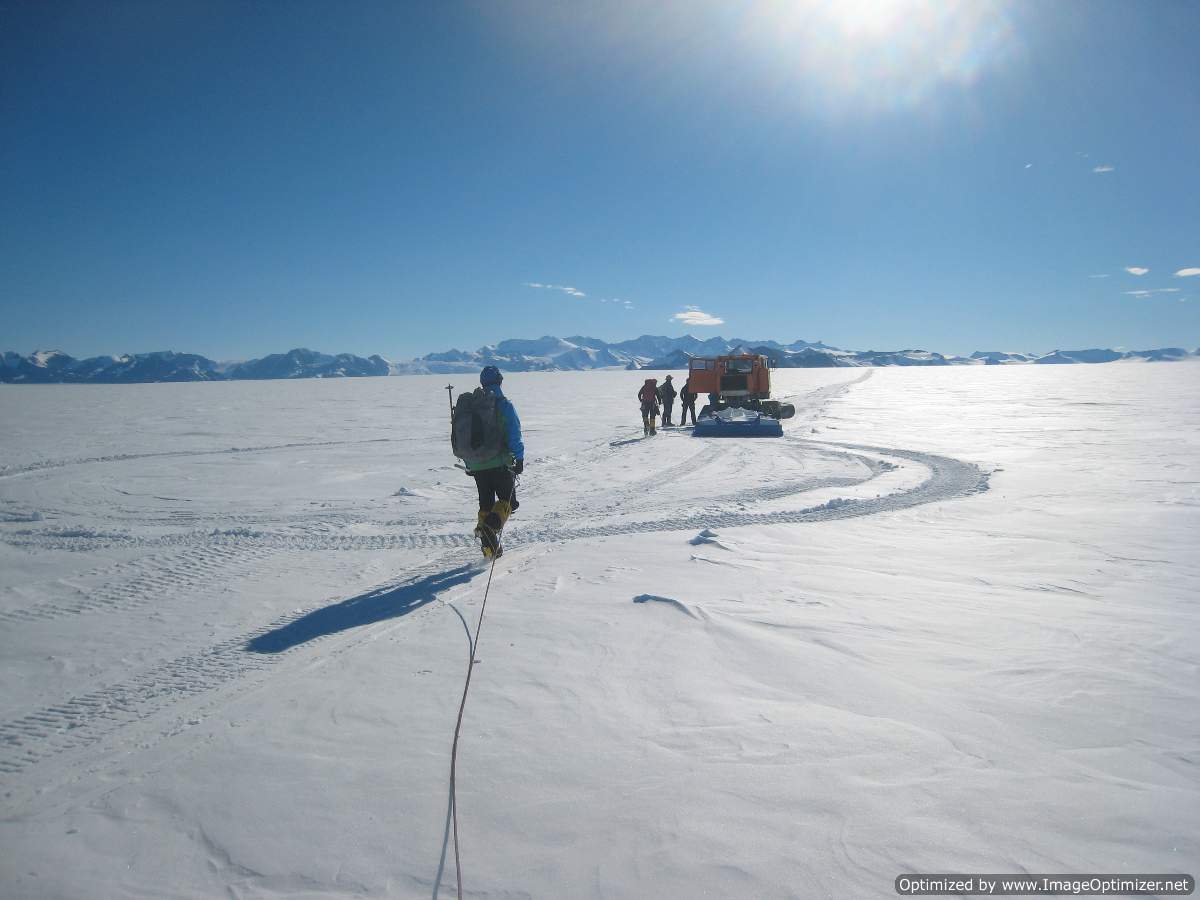
The approach to our climb started with a ride on a snow cat towards the start of the ridge. It dropped us off when crevasse danger on the glacier became too great for the machine to go any further.


Snow Cat used to clear the ice runway also took us to Mt Rossman

The following pictures describe our traverse of Mt Rossman. Although this was the lowest of the three peaks we climbed, it presented most interesting mountaineering challenges.

Cody and the beginning of our traverse of Mt Rossman

Cody on Ridge.  Union Glacier Camp below in center of picture


At the first summit

Main summit in the background

Pacific Ocean is not far to the west


Summit of Mt Rossman

After completing our climb, we were picked up by the snow cat at the other end of Mt Rossman and brought back to the Union Glacier Camp

Snow Cat pickup

A few days later we were flown back to Punta Arenas.

Back in Punta Arenas

Sunday, January 27, 2013

Mt Shinn


 After Cody and I reached the top of Vinson four days after leaving Punta Arenas, we still had ten more days before our scheduled flight on the Ilyushin 76 back to Chile.  We were interested in climbing some other peaks in the area with the time we had.  But most of the other climbers were on a quest to climb each of the highest mountains on the seven continents. So after climbing Vinson (the highest in Antarctica), they were not interested in making other ascents. But a small group of us wanted to use our time to climb some other peaks in the area. Mt Shinn, the third highest mountain in Antarctica, was easily accessed from High Camp so we made that our next objective..

Mt Shinn from High Camp

To access Mt Shinn from High Camp, we needed to drop down to the col (pass) between Mts Shinn and Vinson. Less than a decade ago, the normal route on Vinson climbed up to this same col. But ice falling from  seracs onto the slopes below made for hazardous travel. So the route was moved to the slope that led to the ridge just below the new High Camp.

Crossing the Col towards Mt Shinn

It was windier and therefore colder on Mt Shinn when compared to our summit day on Mt Vinson. My camera was completely frozen, but Cody's worked on the summit.

Cody and me on the summit of Mt Shinn (C. Smith photo)

On the descent, clouds moved up from below and engulfed us in a fog. We couldn't see where we were going and had to use GPS coordinates to find our way back to High Camp.

Given all the potential weather delays, we now needed to get back to Vinson Base to make sure that we had enough time to be flown back to Union Glacier.  It took one day to make this descent from High Camp to Vinson Base.  From there the Twin Otter flew us back to Union Glacier.

Saturday, January 26, 2013

Vinson Summit Day


From High Camp the route climbs a gentle snow slope up into a basin below the summit of Mt Vinson.

Summit of Mt Vinson . High Camp on flat spot on ridge in right of photo (photo by C. Smith)

The climbing was easy snow walking, but extremely cold in places where there was any wind. With temperatures below -20 I had to have full coverage of any exposed skin to prevent frostbite. I found it difficult to keep my face covered without water vapor from my breath seeping up into my goggles and fogging them up.

Cody Smith on his way to the top.  Mt Shinn in the immediate background

The other issue I had was my camera kept freezing up. I put it in an inside pocket to keep it warm. But I could only get of one or two shots each time it took it out before it would freeze again. Replacing the battery with one that I had placed in my glove allowed me to take additional photos. But my fingers became dangerously cold whenever I had to take my gloves off to replace the battery.

Cody and Seth on the summit ridge

From the summit ridge we were rewarded with spectacular views of the entire Ellsworth Range to the south.


Cody and me on the summit of Mt Vinson


View looking south from the summit

Vinson Base Camp to High Camp


ALE owns a subsidiary Adventure Network International (ANI) whose staff runs Vinson Base and patrols the mountain above there. ANI also employs guides for their own clients on the mountain.

Vinson Base Camp

ANI ensures that ALE customers from other guided groups and their own clients adhere to environmental practices in compliance with their operating permit. This mostly consists of removing all trash and poop from the mountain. Walls built with snow blocks enclose separate toilet areas for feces and urine. The feces toilet has a five gallon bucket equipped with a seat over which a plastic bag is attached to capture the waste, which then fits into a second bag to be packed out. This is easy as it freezes readily in the -20 to -30 degree C temperatures. All urine must be disposed of in a hole in the snow in that toilet area. Urinating in the snow along the climbing path is not allowed except in a few specified locations. You have to use a pee bottle when away from a specified pee spot.

The Toilet

Cody and I chose to ski rather than walk up the glacier up to Low Camp. This would make it a lot quicker to come down. We had to ski roped together to protect each other in case of a crevasse fall.

Skiing to Low Camp

At Low Camp there was a large cooking tent already set up for us to use. We spent the night there in tents cached for ANI clients before heading up to High Camp.

Seth carrying bag of snow to melt in Low Camp Cook Tent (photo by C. Smith)

The climb from Low Camp to High Camp ascends a 35 degree snow slope that has been equipped with about 2000 feet of fixed rope.

Slope to ridge crest and High Camp in center of photo 

On most climbs there would not be a fixed line on such a relatively low angled slope. But given the wide variation in climbing skill amongst those on Mt Vinson, the rope provides added safety on the steepest part of the route.

Climbing  up to High Camp

Cody and I got to the high camp a day ahead of most of the other climbers and it was nice to have the place to ourselves for at least a day.

High Camp

From High Camp there were beautiful views of Low Camp and the Eastern Antarctic Ice Shelf. Looking down from the Ellsworth Mountains was a vast landscape with ice stretching to the horizon in every direction.

View towards East Antarctic Ice Shelf


Saturday, January 12, 2013

Getting to Mount Vinson Basecamp

I'm back from Antarctica where Cody Smith and I climbed Mt Vinson, Mt Shinn, and Mt Rossman.  I'm currently travelling to El Chalten were my partner J Mills is already there and anxious for my arrival because the weather is good.  So I will try to post stories of the Antarctica trip as I get a chance.

Antarctica is probably the most logistically complicated and therefore the world's most expensive place to go visit. Getting to the Ellsworth Mountains (where Mt Vinson is located) is accomplished by hiring Antarctic Logistics and Expeditions (ALE) to fly you there from Punta Arenas at the very southern tip of Chile. The ALE flight onto the continent is via a Russian Ilyushin 76. It was probably a good thing that my friend in Seattle who does accident investigations told me in an email after I got back that he worked on the world's worst mid-air accident that involved a collision of an Il-76 and a 747 near Delhi. The problem in that incident was that the radio operator on the Il-76 is seated on a different level of the flight deck and, on the accident flight, the captain who was flying the aircraft couldn't speak English and didn't understand the air traffic controller's altitude calls. The radio operator, who did speak English, failed to pass on the communications. The result was that the inbound Il-76 and the outbound 747 were flying at the same altitude. Fortunately for us there is not a lot of traffic between Punta Arenas and Antarctica. Our Il 76 was operated by Almaty Air from Kazakhstan, and the accident flight was operated by Kazakh Air. So perhaps a relative of Borat was still in control.

Payload Master Watching Us and the Cargo in the Cargo Bay
After a four hour flight, the IL 76 landed on an ice runway on the Union Glacier.  Each season ALE flies in a maintenance crew on a Twin Otter on skies that gets the snow grooming equipment up and running at Union Glacier base camp and plows any loose snow off the ice runway so that the Il 76 can land.

IL 76 After Landing on the Union Glacier
The ice runway is several miles from the Union Glacier Base Camp so we are loaded onto vehicles that can drive on the glacier along a path that is clear of crevasses.

Souped Up Ford Van for Driving on the Glacier
As soon as we arrived at the Union Glacier Camp, we were told the weather was good enough to fly directly to Vinson Base Camp.  At Union Base Camp there is a smaller airstrip where ALE has two twin Otters and a DC-3 - all on skis.  These planes are used for transporting clients within the continent.  We would fly in a Twin Otter to Vinson Base Camp.

Loading into the Twin Otter
After a 40 minute flight we landed at Vinson Base Camp..

Mt Vinson from the Twin Otter
Landing at Vinson Base Camp reminded me of landing on the SE fork on the Kahiltna Glacier on Denali.  After bouncing and sliding along the uneven runway we slid to a stop.  On our first day out of Punta Arenas we were ready to start our climb.


Twin Otter Landing at Vinson Base Camp


Friday, December 28, 2012

Punta Arenas is the Jumping off Point for Antarctica


My latest adventure is to try and climb Mt Vinson in Antarctica.  Two days ago I flew from Seattle to Punta Arenas at the southern end of Chile.  Punta Arenas is a port city on the Straights of Magellan and is arguably the southernmost city in the world.


Straights of Magellan and Punta Arenas

 Tomorrow morning I fly on a Russian Ilyushiin 76 cargo jet across the Drake Passage to where we land on the Union Glacier in Antarctica.  I get back to Punta Arenas in about two weeks and then I will report on this adventure when I get back

Ilyushin 76 Cargo Jet

The Really Big Drip and Early Ice in the Canadian Rockies

There was a lot of good early season ice this November in the Canadian Rockies.  This was especially true up on Mt Wilson near the Saskatchewan River Crossing on the Icefields Parkway.  Two seldom formed routes, Shooting Star and Dancing with Chaos, were in.  There was minimal avalanche danger with the low snow pack on a mountain that is famous for big slides later in the season.


Dancing with Chaos
 Mark Cosslett and I did both these routes on a couple of trips up there.  We stayed in the Rampart Creek Hostel that was open but empty this time of year.

Mark Cosslett Following the Second Pitch of DWC 


  I had climbed Shooting Star several years ago the last time it formed.  Like my earlier experience, the first pitch was thin and technically getting over some ice blobs at the bottom. 

First Two Pitches of Shooting Star
On my previous ascent I got to lead the free standing pillar on the third pitch which comprised the best climbing on the route.

Third Pitch of Shooting Star
This time Mark had the privilege of going first and putting the rope up for me.  Ice climbs like this are such a special treat!

Mark Cosslett Starting up the Pillar
In the Ghost River area, there is a magical place called the recital hall.  It is a natural amphitheatre that is 200 feet in diameter surrounded by 200 foot high limestone walls.  You can only access it by trekking up a gorge with some short easy ice steps and a final rope length of Grade 4 ice.  Inside there are two seldom formed ice climbs that spill into the Recital Hall to create some of the most beautiful ice formations that I have ever seen.  This year, Rainbow Serpent, a climb on the south side of the Recital Hall had formed, but the other route, Fearful Symmetry, on the north side was only partially formed.   I was with two new German friends, Matthias Scherer and Tanja Schmitt who I met at the International Mountain Summit in the Dolomites in October.  I had climbed both these routes before, so the visitors got to lead and Matthias made quick work of it for a wonderful day out.

Matthias Scherer on Rainbow Serpent

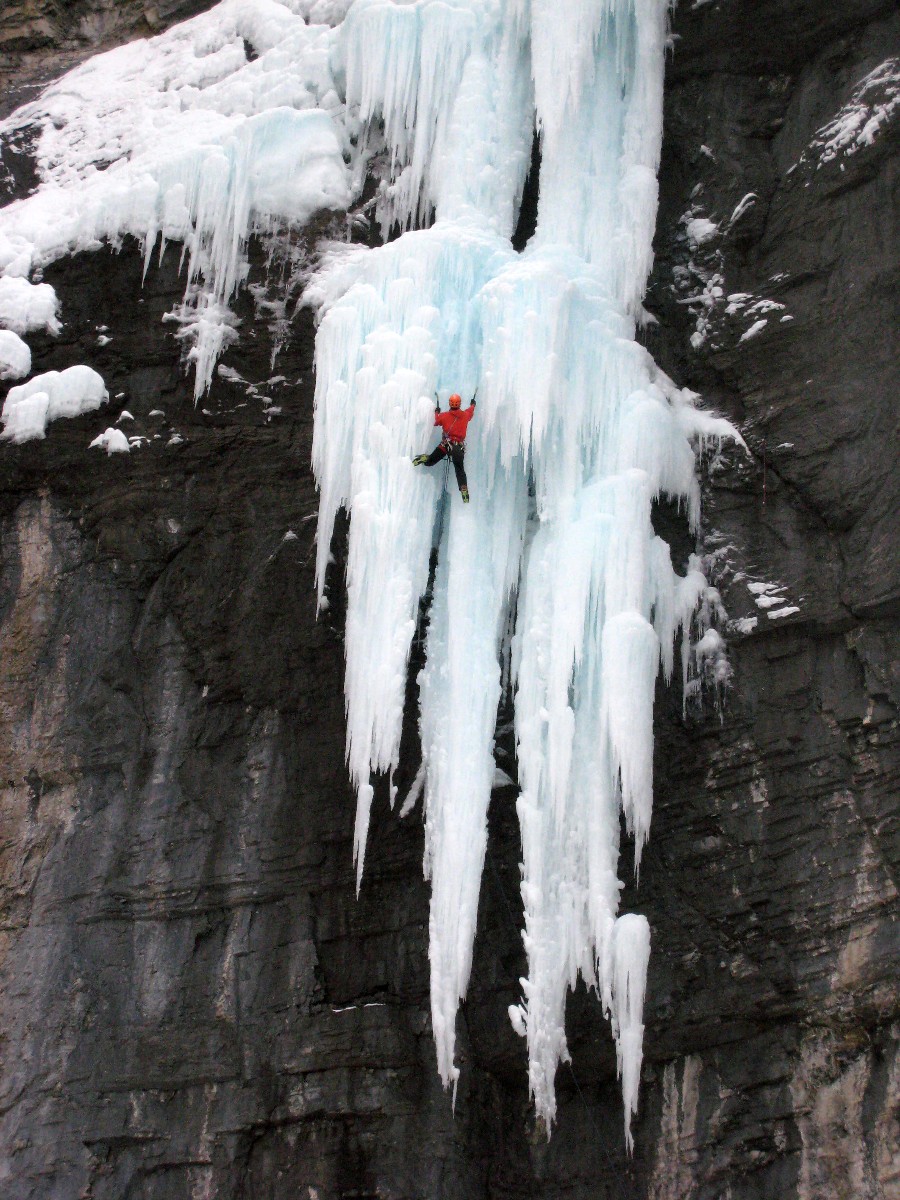
I've always wanted to do the Really Big Drip.  Driving into the Ghost River it stares at you from the wall on the other side.  This year I heard that the lower icicle was hanging lower than usual and that the climb was in good condition.


The Really Big Drip
In mid December I headed in there with Raphael Slawinski and Juan HenrĂ­quez.  My thought was if Raphael wanted to lead that was fine and if I felt good on it I could come back later with someone else and lead some of the pitches myself.

Raphael Slawinski on the 1st Pitch of TRBD
 I felt good following the first pitch even though it was chossy rock.  Stepping onto the dagger was spectacular!  Juan pulled of a huge piece of the loose flake on the first pitch when he followed it.

Raph on TRBD
Above the dagger was a nice bolted belay on a ledge in a protected cave behind the ice.  The second pitch was ice that looked to be overhanging in one section, but were able to sneak past where the overhanging ice was offset making it much easier than it looked.

Squeezing through the Ice to the Outside of the Dagger
The third pitch kicked my ass.  It was rated M7+, but I felt that you needed to be a solid M9 climber (which I'm not) to red point it.  I ended up pulling on some of the bolts to get up and I realized I needed to be much stronger if I was going to lead it.

Raph on the Crux 3rd Pitch
Up on the Thompson Highway there is a great mixed climb called Unicorn next to the classic waterfall called Kittyhawk.

The Unicorn is the Mixed Climb left of Kittyhawk on the Right

Gery Untrasinger and I climbed The Unicorn a few days after I was on TRBD.  I led the first pitch up a technical slab then over the overhang. 

Leading the First Pitch of The Unicorn

The first crux was getting onto the ice above the overhang. 


Climbing the Second Crux
 The next crux was climbing a pillar onto a comfortable belay ledge. 


Gery Unterasinger Squeezes through on the 2nd Pitch

The final pitch benefited from the abundant ice that allowed Gery to stem his way out and through a hole in the far side of the curtain.  It was a great day on the mountains.


Squamish


I apologize for not updating my blog for some time.  I will try to bring you quickly up to date on summer activities first.
I spent July through September for the most part in Squamish British Columbia.  I consider this area to be the premier destination for North American summer rock climbing.  I'm lucky to have it three and a half hours from my summertime home in Seattle.  It has everything from world class boulder bouldering to amazing multi-pitch trad climbing - all on high quality granite.

Climber on Cruel Shoes on the Grand Wall
   Most of my life I have been an alpine climber and did most of my training for that.  I have taken time to rock climb for only brief periods, and I've never trained specifically for it.  As a result I've struggled to make progress on anything much harder than 5.11+ on a good day.  Before going to Squamish to rock climb
for the summer,  I wanted to learn how to train for it.  I consulted with Tyson Schoene, the coach for the Vertical World team in Seattle.  He gave me week by week training routines during the months of May and June.  In general the workouts consisted of progressively harder endurance and power sessions that took about two and a half hours per day.  At 58 years old I wasn't able to do everything in these regimens without getting injured, nor would I be able to climb as well as I could have if I did this when I was younger.  But I did get stronger.

Grand Wall with The Split Pillar and Sword of Damocles Flake on Left


  By July 5th the wet spring was over and when the sun came out, it did so until October.  During this almost unprecedented spell of dry weather, I journeyed north to try out my body on the cliffs.  Things started slowly as I got accustomed to the movement and placing gear.  By early August I was red pointing 5.11- on long multi-pitch routes like Freeway.  But I ignored one of Tyson's suggestions to keep up my training routines in Squamish by bouldering or going to the rock gym.  It was fun to just go climbing most days with local partners like Geoff Hill and whoever was available mid-week.  By the end of August I red-pointed the 5.12a corner on the Daily Planet, something I hadn't been able to do before. 


Freeway Route on the Tantalus Wall

I set my expectations higher now for a long route like Norther Lights, a 5.11+ to 5.12- route on the North Wall.  To prepare, I went out in early September with Paul Cordy to climb The Alaska Highway, which is the name for the lower half of Northern Lights.  But it was a discouraging outing.  I was weak and incapable of leading anything hard without hanging from my gear.  For the rest of that month I continued to slip to where I now struggled with easy 5.11s. My Squamish time was wonderful, but didn't end like I had hoped.  What went wrong?  I was confused as to why I got so much weaker the last few weeks. 


Northern Walls - Northern Lights Climbs Wall on the Left

I consulted with Tyson once I got back to Seattle and after I explained my regimen he was not surprised by what had happened.  I made several rookie mistakes. 
  • I hadn't structured my climbing time to make sure I was getting a consistent combination of endurance and power training similar to what I was doing beforehand in the gym. 
  • I didn't combine this training with enough rest so that I was ready to send on the days I worked on my hard climbs. 
  • The combination of the above things that led me to get weaker then caused me to lose my motivation. 
I learned that it is possible to work harder but be able to do less.  This is a lesson I knew a lot about for the cardio training I had done for nearly 45 years, but I didn't understand these rules applied to upper body training.  I still have a lot to learn, but maybe I can benefit from this experience and get to a place where I can red point some of my projects before I get too old.